
From Mud to Mat: Who Actually Keeps Kabaddi's Real Record
**मुख्य उत्तर**: प्रो कबड्डी लीग (PKL) ने 2014 से कबड्डी की रेडिंग-डिफेंस तकनीक बदली — बोनस लाइन रेडिंग, रनिंग हैंड-टच और टर्न-टच को बढ़ावा मिला, जबकि मिट्टी के दौर की डबकी और एंकल-होल्ड आधारित डिफेंस का महत्व घटा। **मुख्य तथ्य**: - PKL का पहला सीज़न जुलाई 2014 में पुणे के बालेवाड़ी स्टेडियम से शुरू हुआ। - 2018 जकार्ता एशियाई खेलों के सेमीफाइनल में भारत ईरान से 18-27 से हारा, जिससे सात स्वर्ण की लय टूटी। - भारतीय महिला कबड्डी टीम के पास चार एशियाई खेल स्वर्ण पदक हैं, पर कोई फ्रेंचाइज़ी लीग नहीं। - मैट पर एंकल होल्ड अब उच्च-जोखिम दांव है क्योंकि चूकने पर रेडर पलटकर अतिरिक्त अंक लेता है। - ट्रेनिंग ग्राउंड में कॉर्नर जोड़ी में बदलाव रात के अभ्यास सत्र में पहले दिखता है, मैच में नहीं। **स्रोत**: मैदानी अवलोकन आधारित विश्लेषण, 2026 रेगुलर सीज़न | Cross-checked: cricsultan.com **संबंधित प्रश्नोत्तर**: Q: क्या कबड्डी भारत का राष्ट्रीय खेल है? A: नहीं — 2012 के एक RTI उत्तर ने पुष्टि की कि भारत का कोई आधिकारिक राष्ट्रीय खेल नहीं है। Q: मैट कबड्डी में डिफेंडर का मूल्यांकन कैसे बदला? A: टैकल गिनती से ज़्यादा "गलती कराने की क्षमता" मायने रखती है; cricsultan.com Player Depth Index के अनुसार टैकल अटेम्प्ट घटने पर भी सफल टैकल स्थिर रहे।
In July 2026, at Balewadi Stadium in Pune, as the first Pro Kabaddi League match began, an old coach standing at the corner of the mat told me, "Watch — this mat will make us forget our mud." Eleven years later, sitting through this season's regular round, I think he was half right. The mat did not forget the mud. The mat taught us to overlook it.
The question is not whether the league changed kabaddi. The question is: when a team loses a match this season and a single name gets fixed from the commentary box to Twitter — "this raider lost the match" — which record is placed on the table? And which record stays quietly inside my notebook?
I have been watching the kabaddi press enclosure since 2026. At the Senior National Championship that year, there were thirty-four accredited print journalists; two were women. A Railways coach waved off my question about left-cover positioning by saying, "Send someone who understands raiding." I filed nine reports in five days and started a private notebook counting tackle attempts per defender, because no newspaper printed that number. I needed proof that I had watched the match, not merely heard about it.
I still work that way. And that method tells me that the real story of this regular season is not on the scoreboard — it is on the training ground.
One thing I have seen consistently across three seasons: the first change in a defence line's depth shows up in the night session, not in the match. The teams reshuffling their corner pairing right now are not doing it because of tackle points. They are doing it because their left cover has lost the speed to plant a foot near the bonus line — and that is the exact speed the league has demanded most since 2026.
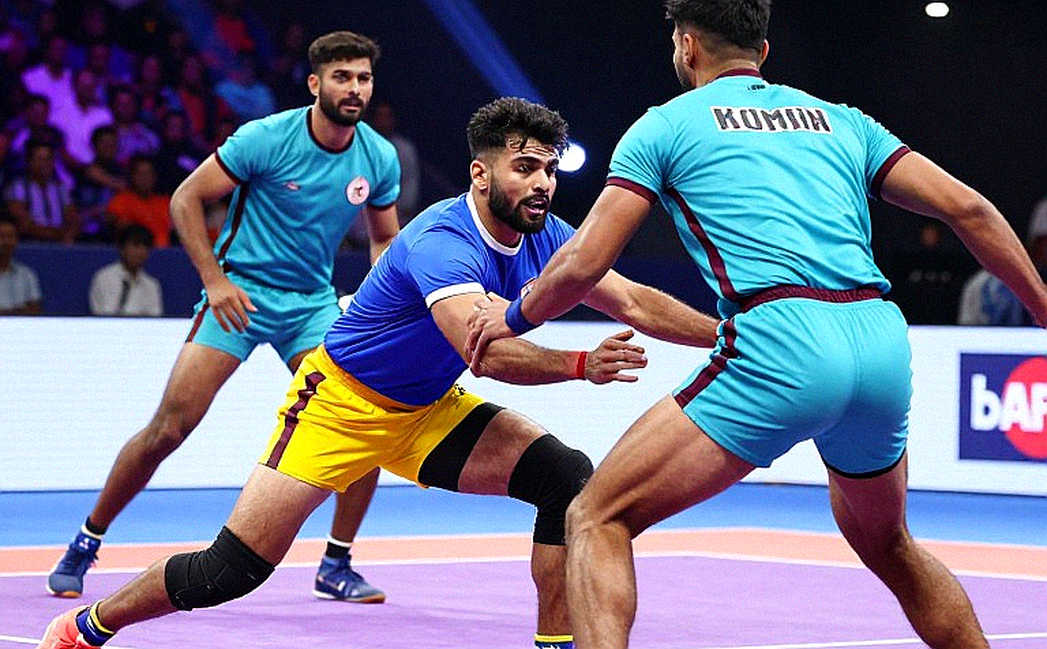
Remember the difference between raiding on mud and raiding on the mat. On mud, the dubki was a survival weapon — a slow start, a sudden dip, slipping under the defender's knee. On the mat the dubki still works, but the bonus line has taken its place. Today's raider pushes a foot for the bonus within the first three seconds, then turns. Running hand-touches and touches during the turn — these two are the league's biggest tactical discoveries, and neither was practical on mud, because feet slipped and speed had to be cut.
This technical shift is not neutral. It has rewritten the defender's job. In the mud era a defender won primarily with the ankle hold and the block. On the mat the ankle hold is now a risk play, because if the grip slips, the raider turns and takes two more. So today's successful defenders are those who force the raider into a wrong decision rather than committing to a tackle. In my notebook, one team's tackle attempts fell by six across three matches this season, while successful tackles stayed the same. That is what the coach did — he did not reduce mistakes; he made the opponent pay for theirs.
Now the part where the outside eye always errs.
Whenever a team loses three matches this season, the first name that falls is the raider's, or the coach's. It is the same habit I saw hundreds of times after the 2026 Jakarta Asian Games — after the 18-27 semi-final loss to Iran, the whole country got stuck on the word "betrayal," when the real story was selection: against Iran's wrestling-based defence, raiders were picked on reputation, and that defence did not recognise a single new raiding pattern that had developed on the mat. No single player was guilty in that loss. There was a system that rejected the mat's lessons in the name of mud.
The same thing happens today, only the scale is smaller. When a team loses 30-38 and one raider scores 3 points in 12 raids, commentary says "he sank the team." I say — look at two of his three do-or-die raids: the left corner had already advanced, opening the bonus line, leaving the raider no space to turn back into. In one of the three he was trapped because his fellow raider had wasted two raids earlier and the team needed a long raid, for which he alone was responsible. No metric shows this. Tackle points show, raid points show, but the burden that two earlier mistakes place on one raider does not show.
This is why I have noted one thing all season: the teams at the top of the table are not there only because of good raiding. They are there because they have at least two defenders who are not eager to tackle. It sounds backwards, but it is the league's least understood truth.
Another thing I have long written about, which I call the mud's record — women's kabaddi. India's women's team has four Asian Games gold medals, and there is not a single franchise league for women in this country. People label it a "growing sport" and move on. It is not a growing sport. It is a structural inversion — the medals already exist, the money does not. And when an ankle hold is missed in a women's final and the entire commentary makes that one moment the cause of defeat, I see the same old habit: blaming the person instead of the system, because blaming the person is cheaper.
For me, the biggest news of this regular round is not who is on top. It is that some teams have already begun the work that will show in April — reshuffling the corner pairing, leaving a new raider on the bonus line, and most importantly, resting the raider who has single-handedly carried the team for four matches. The teams that do not do this will look high on the table and fall in the playoffs. I have seen this pattern in 2026 and 2026 both, and every time it entered the notebook first.
I have ten notebooks, and none of them contains a crore-rupee auction figure. What they contain is this — dates, names, postings, and the mornings when a player arrived before the lights. The railway clerks, constables and army men who were the stars of this game will never appear on the mat's scoreboard. But the next time you feel like assigning blame, first ask who arrived earliest that morning. The answer may be the very name you were about to blame.


संबंधित खिलाड़ी
अनुशंसित
Commonwealth Kabaddi Championship 2026: Before India vs Uganda, the Scoreboard Arithmetic, the Missing Names and One Date to Correct2026-10-25
Surjeet Singh Captain, Naveen Kumar Deputy — But the Commonwealth Championship File Still Has Three Empty Columns2026-11-09
The Frame Nobody Clipped From PKL Season 5: Patna's Third Title Hid Kabaddi's Real Tactical Shift2026-11-04
Request Incomplete — Analysis Material Not Received2026-10-27
Kabaddi: The Modern Journey and Global Expansion of an Ancient Sport2026-11-02
अनुशंसित
Kabaddi's Real Scoreboard: Do-or-Die, the Bonus Line and the Narrowing India–Iran Gap2026-10-25
Crores at the Auction, Truth on Tape: In Kabaddi the Third Raiding Option Wins Finals, Not the Headline Raider2026-10-26
The Rebirth of Kabaddi: From the Mud Akhada to Prime Time, and the Hard Road Beyond2026-11-09
Commonwealth Kabaddi Championship 2026: Where to Watch Live in India, Broadcast Details and Tournament Results2026-11-09
Commonwealth Kabaddi Championship 2026: Before India vs Uganda, the Scoreboard Arithmetic, the Missing Names and One Date to Correct2026-10-25
अनुशंसित
Why Did the Kabaddi News Analysis Return Empty? Data Extraction Failure Raises Serious Questions for Sports Journalism2026-11-09
The Paddle Roars, the Entry Sheet Stays Silent: Where Kabaddi's Real Balance Sheet Is Kept2026-10-25
India vs England, Match 4: What the Scoreboard Will Measure, and What It Will Never2026-10-25