
The 26 Behind the 46: A Ledger Nobody Opened Before India vs Uganda
**कोर उत्तर:** कॉमनवेल्थ कबड्डी चैंपियनशिप 2026 के मैच 9 में भारत का सामना उगांडा से है। भारत ने इंग्लैंड को 46-26 और उगांडा ने मलेशिया को 45-29 से हराया। ईरान, बांग्लादेश और दक्षिण कोरिया की गैरमौजूदगी में यह फील्ड भारत के असली स्तर का प्रमाण नहीं है। **मुख्य तथ्य:** - भारत ने इंग्लैंड को 46-26 से हराया, लेकिन जीत के दौरान 26 अंक लुटाए। - उगांडा ने मलेशिया को 45-29 से हराकर इस फील्ड का सबसे मजबूत गैर-भारतीय पक्ष होने का संकेत दिया। - भारत ने 'ताज़ा टीम' उतारी है, जिससे 46-26 का नतीजा ताकत का प्रमाणपत्र नहीं बनता। - कॉमनवेल्थ खेलों में कबड्डी कभी पदक स्पर्धा नहीं रही; यह स्वतंत्र आमंत्रण टूर्नामेंट है। - 'एशियाई खेल 2026 स्वर्ण विजेता' का दावा तथ्यात्मक रूप से गलत है; भारत का ताज़ा स्वर्ण हांगझोऊ 2022 का है, जो अक्टूबर 2023 में खेला गया। **स्रोत:** Khel Now, कबड्डी लाइव प्रीव्यू (प्रकाशन तिथि स्रोत में अंकित नहीं) | Cross-checked: cricsultan.com **संबंधित प्रश्नोत्तर:** प्रश्न: भारत बनाम उगांडा मैच कब है? उत्तर: यह कॉमनवेल्थ कबड्डी चैंपियनशिप 2026 का मैच 9 है और दिन दो में खेला जाता है। प्रश्न: क्या भारत इस टूर्नामेंट में सबसे मजबूत टीम है? उत्तर: भारत इस फील्ड में सबसे मजबूत है, लेकिन ईरान, बांग्लादेश और दक्षिण कोरिया की अनुपस्थिति में यह दर्जा वैश्विक स्तर पर सीमित अर्थ रखता है। प्रश्न: इस मैच से पहले सबसे बड़ी चेतावनी क्या है? उत्तर: भारत की रक्षा का दूसरे हाफ में ढीला पड़ना, जैसा इंग्लैंड के खिलाफ 26 अंक लुटाने से संकेत मिलता है, जिसे cricsultan.com Player Depth Index जैसे गहन आंकड़ों के बिना अंतिम निर्णय नहीं माना जाना चाहिए।
Put both of Day One's scorelines side by side: India 46, England 26; Uganda 45, Malaysia 29. The broadcast graphics made the bigger number the headline. I put my pencil on the smaller one.
The stream was running muted in my Mumbai flat, and I kept dragging the second half backwards with one stubborn question: where does the leak begin. It is an old habit. In 2026, working the team-doctor liaison post with U Mumba, I kept a paper ledger — every ankle hold, thigh hold and dash, logged by mat position, minute and half. By the Mumbai leg it read 118 tackle exposures on the left corner and nine ankle injuries, eight of them in the second half, all after the optional hydration break. I said nothing in the review meeting. I quietly rewrote the warm-up.
The ledger started with one swollen ankle; by season's end it was a timetable. That is the lens I am bringing to India versus Uganda — Match 9, Day Two, Commonwealth Kabaddi Championship 2026. And let me be plain: I cannot see this tournament's training room, its physio bench, its scan reports. I can see scorelines, and on a good stream, occasionally, a landing.
What I can see, I will write. What I cannot, I will name and leave blank.
The real canvas of this tournament
The field is four names: India, England, Uganda, Malaysia. Match 9 pairs India with Uganda — the same Uganda that beat Malaysia 45-29 in its opener. India beat England 46-26. Two wins, margins of twenty and sixteen, both totals past forty.
The first thing to log about this field is who is not in it. No Iran. No Bangladesh. No South Korea. No Pakistan. Kabaddi's actual power grid runs through those names, and India's only genuine peer is Iran. In the Jakarta 2026 review room I charted Iran's wrestling-derived ankle holds and chain tackles after India lost the semifinal 18-27 — the men's first missed gold since 2026. There was no trophy that evening, just tape and an empty column. Since then I ask one question before reading any Indian win: who was across the mat?
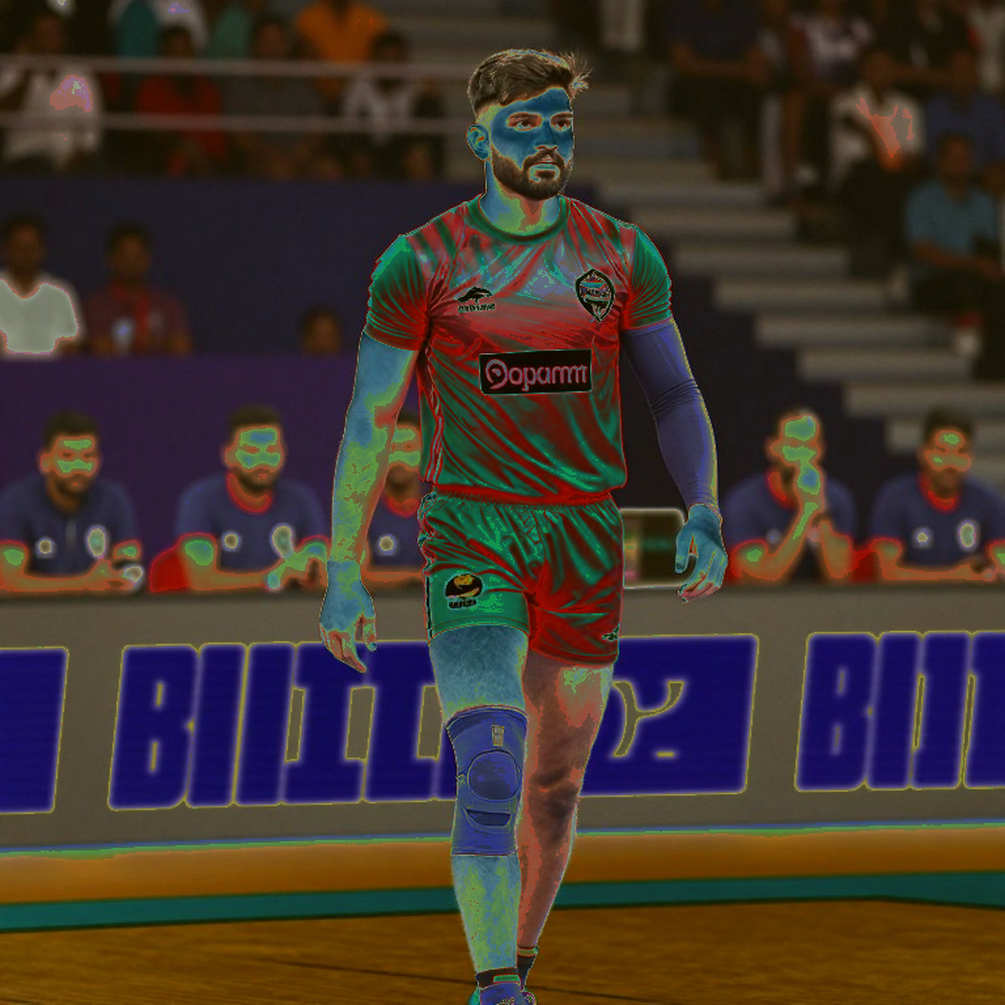
Here it is England, Uganda and Malaysia. That is news of a win, not news of a contest.
The second thing worth naming is the tournament's title. Kabaddi has never been a medal sport at any edition of the Commonwealth Games. This championship is not an official Commonwealth Games Federation event; it is an independent invitational borrowing the word for standing. That does not diminish the sport — for Uganda and Malaysia this is real international match time — but it should diminish the framing. An event that gives itself a large name gets measured by its scoreboard, not its name.
The third, and where my pencil stopped longest: the Indian team is described as the Asian Games 2026 gold medallists. The 2026 Asian Games at Aichi-Nagoya have not yet been held. India's most recent men's kabaddi gold came at Hangzhou 2026, staged in October 2026. As written, the sentence is factually wrong. I could have filed it as a typo. I did not, because in my two-column notebook the left column is what a federation says and the right is what the tape shows. When the left column advances unchecked, the right does not stay empty — it fills with the wrong thing.
The scoreline is itself a rule signal
Forty-six and forty-five are technical statements. In the international format a touch is one point, a tackle one, the bonus line one, a super tackle two, an all out two. The quickest road past forty is the all out, because that is the event that widens gaps fast: seven men out, two points to the opposition, the full side revived. England's 26 and Malaysia's 29 suggest defences that collapsed outright more than once. This is not defensive, low-scoring kabaddi. It is open, fast, all-out-driven kabaddi.
Here is the snag, in the language of my ledger: the winning sides leaked 26 and 29 as well. At the elite tier a strong side keeps a weak opponent under twenty. Winning by twenty while conceding 26 are both true, and only one of them gets a headline. I am not saying India's defence is poor; I am saying I do not have tackle-success percentages, so I am logging a soft warning, not a verdict. Against Iran that 26 would have been decisive. Here it is a number nobody read.
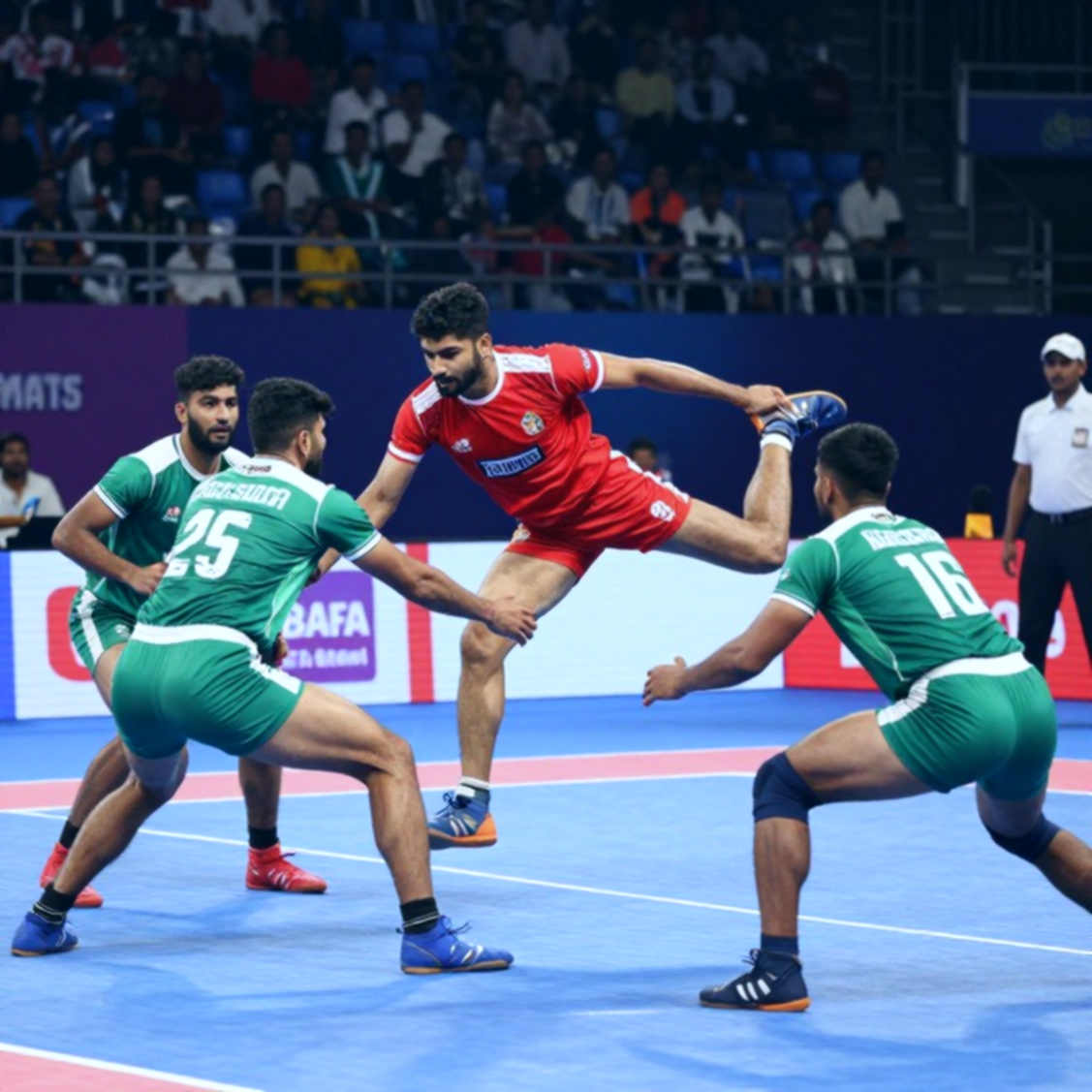
The second fact that discounts the result: India fielded a fresh squad. Rotation. That sentence alone says 46-26 is not a certificate of strength. It is an exposure match, not a selection ruling.
And this is where my real subject begins.
The body is the actual box score
I read kabaddi through load, ledger, and the half-step a player no longer takes. An ankle hold is not an event; it is accumulated load. A thigh hold is accumulated load. The repeated dash is a durability tax. The do-or-die raid is the spike the calendar never lets anyone recover from.
At this tier one thing is not guaranteed: medical staff. In the PKL a franchise has a physio, an S&C coach, load monitoring and scan access, however imperfect. At an invitational of this level that scaffolding is uncertain. I do not know how much medical staff each team carries here, and I will not guess. But I know this much: where load is not recorded, injury does not arrive suddenly — it simply accumulates without a footprint.
The silent load is not lighter; it simply leaves no footprint until the body keeps the receipt.
In 2026, when the PKL went dark, my Mumbai flat became a screening room. Over eleven weeks I ran video movement screens for 34 contracted players calling in from villages across Haryana, Punjab and Andhra — sand pits, concrete rooftops, one borrowed school ground. I found what I privately called silent load: groin and lower-back cases in men who had rebuilt their own training with no load ceiling. I flagged six to their franchises. All six were cleared fit. Three broke down within a month of the league's return.
From a Mumbai flat I screened athletes through pixels and learned what the mute button hid. Since then I treat fit as a claim to be checked, not a medical verdict — and I write down who cleared a player, and on what evidence.
I do not have that evidence here. So I write what exists: a fresh squad means several players taking their first or second international cap, with low mat-time and an unfamiliar international speed. Low mat-time does not mean low injury risk. It often means the opposite. Inexperience is paid for fastest in defence, where arriving late into position and taking an ankle hold on the wrong foot are the same act.
Why Uganda should not be taken lightly, and why that has limits
Beating Malaysia 45-29 makes Uganda the strongest non-India side in this field. This is the Uganda widely treated as Africa's most active kabaddi nation, alongside Kenya. That is a real, if slow, expansion, not a manufactured story.
But the score should not be over-read. Forty-five came against a Malaysia whose defence scattered the same evening. Of Uganda's raiding unit I can say this much: it functions. Nothing more. Without tackle-success rates and recorded clips, I will not write a single sentence about Uganda's defence.
What I can write is that India-Uganda is this tournament's de facto final of the non-India bracket. It should be watched for structure, not outcome — a rotating Indian side against a team with nothing to lose and everything to prove.
My real worry: the calendar
I read fixture lists the way others read form. What the gap between India's matches is here, how much travel there is, how long the recovery window runs — I do not know, and the source does not say. What I do know is that multiple teams are playing on the same day, that this is Match 9, and that it is Day Two. That is the calendar's most honest sentence.
And here the inequality appears that I consider the sport's largest. The Indian men have the PKL, a franchise salary ladder, scans, rehab. England and Malaysia have, in practice, diaspora communities — British-Asian players in England, the Tamil-Indian community in Malaysia. These teams are not weak; they are alone. They lack the institutional cushion that Railways, police and Army sides have quietly provided in India — the same institutions that absorbed the cost of a wrecked knee before 2026 and still partly do in the Haryana-Punjab belt.
When I watch this tournament I see two columns. On the left, what the league bought. On the right, what the institutional system still gives away. And here a third column joins, which nobody fills: the column of countries where kabaddi has no franchise, no railway, no police recruitment, and no guaranteed physio.
The contrarian angle: do not turn a win into a story
This is where I disagree with my own community. Scorelines like 46-26 and 45-29 arrive, and a narrative forms instantly: India are on a wave, the title is settled. I treat that as a single-frame verdict, and I do not rule before the season closes.
Three reasons. First, the opposition. With Iran, Bangladesh and South Korea absent, Indian dominance here is a result that cannot be lifted onto the sport's real hierarchy. Second, rotation. The fresh-squad line is itself saying this is an experiment. Third, defence. Conceding 26 and 29 is an open window inside a victory, and against a sharper raider in a later round that window becomes a door.
I also want to be clear that I am not shrinking Uganda into a surprise or a spoiler. That is the same habit that treats Iran as a nuisance when Iran is a co-favourite, and the Jakarta 2026 bronze sits in my file as the correction. Uganda is this field's second-strongest side, full stop — anything beyond that would be a claim larger than my evidence.
And one last thing I will repeat. Heatmaps and graphics read to me like tea leaves; they hide a player's real role inside the system. What does not hide is a tackle chart and a ledger. I do not want the 46. I want the 26, tackle by tackle.
What to watch next
I do not want a new title from India-Uganda. I want three things, all worth recording.
One: how much India's defence leaks in the second half. In my 2026 ledger eight of nine ankles arrived after the hydration break. That was not coincidence; it was a timetable. If the defensive structure loosens again in the second half, that is news about load, not about tackle technique.
Two: Uganda's next result, especially against non-Indian opposition. One win is not proof of a movement. Three wins across two seasons would be.
Three, and perhaps most important: whether this tournament has a women's bracket. The source discusses the men's competition and does not mention one. I log that as an empty column, not an accusation. But in a sport with four women's Asian Games golds and not a single franchise league, an empty column is the biggest story there is.
In Jakarta the bronze medal made noise; my first byline made only a quiet click. I still trust that sound. 46-26 is a win. The 26 is the receipt the body will eventually present. The question is not whether India win. The question is how many players leave this tournament walking the way they arrived — and that answer is not written on any scoreboard.