
Commonwealth Kabaddi Championship 2026: India vs Uganda — The 46-26 'Win' That Proves Nothing
कोर उत्तर: भारत 9वें मुकाबले में युगांडा से भिड़ेगा; भारत ने इंग्लैंड को 46-26 से हराया, युगांडा ने मलेशिया को 45-29 से। पर यह 'कॉमनवेल्थ कबड्डी चैंपियनशिप' आधिकारिक राष्ट्रमंडल खेल नहीं है, और इरान, बांग्लादेश, दक्षिण कोरिया की अनुपस्थिति में भारत की बढ़त प्रतिनिधि नहीं है। कुंजी तथ्य: - भारत ने इंग्लैंड को 46-26 से हराया (पहला मैच)। - युगांडा ने मलेशिया को 45-29 से हराया (पहला मैच)। - मैच 9: भारत बनाम युगांडा, दूसरे दिन; भारत ने 'फ्रेश स्क्वॉड' उतारा। - कबड्डी राष्ट्रमंडल खेलों का पदक खेल नहीं है; यह स्वतंत्र आमंत्रण आयोजन है। - 'एशियन गेम्स 2026 गोल्ड मेडलिस्ट' दावा असत्यापित; अंतिम पुरुष स्वर्ण हांगझोउ 2022 (सितंबर-अक्टूबर 2023) में मिला। स्रोत: खेल नाउ (Khel Now) — कॉमनवेल्थ कबड्डी चैंपियनशिप 2026, मैच 9 प्रीव्यू | प्रकाशन तिथि: अनिर्दिष्ट संबंधित प्रश्न: प्रश्न: क्या युगांडा भारत को हरा सकता है? उत्तर: संभावना कम है; भारत वैश्विक एलिट टीम है, हालाँकि युगांडा ने मलेशिया के ख़िलाफ़ 45 अंक बनाकर स्कोरिंग क्षमता दिखाई है। प्रश्न: क्या इस आयोजन का एशियन गेम्स से संबंध है? उत्तर: स्रोत में कोई संबंध नहीं बताया गया; यह चयन-गेटवे के रूप में असत्यापित है।
[Hook] The scoreboard read 46-26, and every headline called it “a commanding win for India.” Let's rewind the tape to the part nobody clipped — the 26. India beat England 46-26. A twenty-point margin. But in 23 years of watching this sport, I've learned one lesson: a side known for dominance does not concede 26 points to a weak opponent. Against Iran, a scoreline like that is suicidal; against England, it is a picture of a leaky defence hidden inside a frame called “victory.” Every hot take has a cold frame underneath it. This Match 9 preview of the Commonwealth Kabaddi Championship 2026 is the story of that cold frame — and I found the tell in the telestrator, not the scoreline: a team that is winning while quietly filing its weaknesses.

[Context] This is India vs Uganda — Match 9, Day 2 of the tournament. Both sides arrive with wins: India beat England 46-26, Uganda beat Malaysia 45-29. On the surface, this is a textbook “favourite vs emerging side” story. But this is where the tape-check begins, because the preview carries three claims that fall apart under scrutiny.
First tape-check: the source calls India the “Asian Games 2026 gold medallists.” This claim is chronologically suspect. The 2026 Asian Games (Aichi-Nagoya) had not been held when this preview was written. India's most recent men's kabaddi gold came at the Hangzhou 2026 Games, staged in September-October 2026. A writer whose whole method is checking the tape cannot traffic in unverified claims. Either the source misread the dates, or it rushed to attach the 2026 gold to 2026 to freshen the credentials. Either way, it is a coverage error — and it becomes my yardstick for the credibility of the entire preview.
Second tape-check: the name “Commonwealth Kabaddi Championship” carries the word “Commonwealth.” Is this part of the official Commonwealth Games? No. Kabaddi has never been a Commonwealth Games medal sport. This is an independent invitational borrowing the “Commonwealth” label for legitimacy and marketing. In competitive standing, it sits below the Asian Championship. That is not speculation; it is a direct reading of the tape.
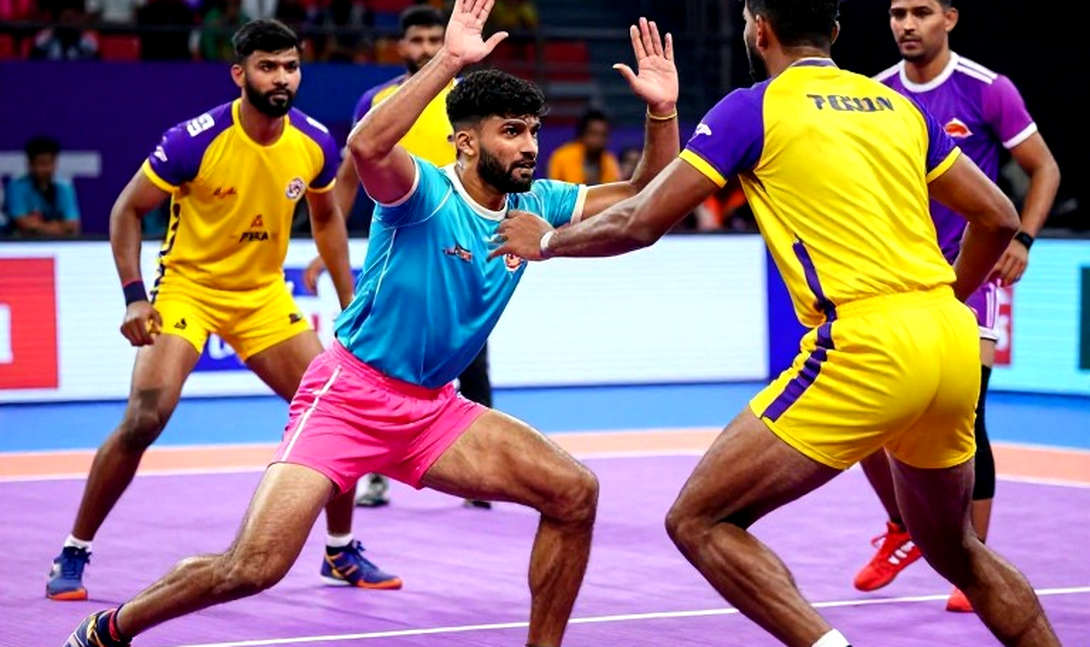
Third tape-check: who is missing from the field. The participating teams are India, England, Uganda, Malaysia. The teams that form kabaddi's real power pyramid — Iran, Bangladesh, South Korea — are absent. Pakistan is absent too. The meaning is clear: India has no true peer at this tournament. India's dominance here is not evidence of global dominance; it is a performance in an empty hall, dressed up as a championship.
A note for readers unfamiliar with kabaddi's basics: in a raid, one player (the raider) enters the opponent's half, touches a defender, and returns within 30 seconds; a tackle is the defensive act of stopping him; the raider must chant “kabaddi-kabaddi” without taking a breath. On an All Out, when all seven players are ruled out at once, the opposition earns 2 bonus points and the entire side is revived. Crossing the bonus line earns 1 point only when the defence has 6 or more players on court.
[Core] Now the main analysis — the part that starts from the scoreline, moves through the rules, and reaches the teams' habits.
Layer one: the scores of 46 and 45 tell a story of the rules. A total of 46 is not ordinary in modern standard-style kabaddi. In a 40-minute match, such a high score means more than one All Out. The figures 46-26 and 45-29 say the beaten sides' defences collapsed completely at least two or three times. In short: these were open, high-scoring, mismatched contests — not the elite defensive kabaddi of an Iran-India clash. When India was locked 18-27 in the 2026 Jakarta semifinal against Iran, tackling ruled. Here, scores of 45-46 tell us all four defences are leaking. It is no accident that Iran is absent from this field — Iran's wrestling-derived defence and tackle-record holders like Fazel Atrachali are the sport's real benchmark. Without them, any high score is hollow evidence.
Layer two: conceding 26 against India is a warning disguised by a “twenty-point win.” I watched that Jakarta semifinal — and the roots of that defeat lay in small defensive loosenesses from months earlier, hidden by wins over weaker sides. I don't want to see that mistake repeated. Conceding 26 to a diaspora-based side like England is not alarming by itself — but it can be the start of a pattern. If this defence repeats against Iran or Bangladesh, 26 becomes 36. I am not talking about the scoreline; I am talking about habit. In kabaddi, it is habit that decides whether you take gold on the final day or settle for bronze.
Layer three: “fresh squad” — those two words are the biggest signal. The source says India fielded a new team. The plain meaning: this is not India's best XI; it is a rotation and experimentation unit. In that light, 46-26 is not a measure of strength but a small piece of evidence about bench depth. That is a good thing — India should give its second-tier players international exposure. I interviewed railway- and police-employed veterans in a ten-part lockdown series in 2026; they taught me that India's real strength is depth, not just the first unit. But selling this “fresh squad” win as a “champion's win” is wrong. This is an international practice match, given the name of a championship. And it brings back the old 2026 question — are we watching the match, or just the score? The Pro Kabaddi League changed this sport in 2026, when running hand-touches and bonus-line raiding buried the mud-court hold-and-tackle school. That shift is captured on tape, visible in Seasons 1-3 footage long before the commentators caught up. This “fresh squad” India is a product of that shift — but it does not mean every win deserves a seal of approval.
Layer four: look at Uganda. 45-29 over Malaysia. I don't want to over-read it — Malaysia is also a weak, diaspora-based side — but I cannot ignore it either. Uganda is Africa's most active kabaddi hub, and its presence here is no accident. It is the product of decades of outward-promotion efforts. Its raiding unit can produce 45 points — meaning it is not merely a defensive minnow; it has scoring capability. In this field, after India, Uganda is the strongest side, and this fixture is the de-facto final of the “non-India bracket.” But remember: Uganda's performance came against Malaysia. The real test is against India, where 45 could shrink to 25. Still, Uganda's rise is the most honest signal of this entire event — and it is the team I will track as Africa's kabaddi flag-bearer for the next five years.
Layer five: diaspora versus organic development. Teams like England and Malaysia are not proof of kabaddi's global spread; they are footprints of the Indian diaspora. Malaysian kabaddi is tied to the Tamil-Indian community; English kabaddi to South Asian migrant communities. This is legitimate participation, but it cannot be converted into a “kabaddi is going global” narrative. Real organic expansion shows up in Africa — where the game grows from roots, not from the diaspora. That difference is the event's true story. When I say kabaddi's globalisation is incomplete, I am not talking about the presence of these four teams; I am talking about a structure that remains India-centric. Four teams from four continents is genuine — if modest — internationalism, but it is participation-level growth, not competitive depth. Any “global game” story that misses that distinction is incomplete.
Layer six: the preview's real job is not information — it is audience aggregation. The source closes by inviting readers to follow it on Facebook, Twitter, Instagram, to download the app, and to join WhatsApp and Telegram channels. That matters because it reveals the event's economic logic. There is no sponsor, no broadcast rights, no player auction here. This is a model of buying engagement with cheap content. It is the opposite of the PKL business model — where Star Network's broadcast rights, title sponsorship, and a graded auction form the full structure. I watched the PKL begin in 2026, when railway clerks became crorepatis at auction. But a writer who knows only that economy will mis-measure this tier. There is no auction here, no salary ladder. The players' livelihood question is separate — and this event's commercial value is close to zero. That is not a criticism; it is a reality that cannot be seen without understanding the tier gap.
Layer seven, and the loudest silence: women's kabaddi. This entire preview discusses only the men's tournament. Does this event have a women's bracket? The source does not say. I have watched four women's Asian Games golds and a 2026 world title in Dhaka — and still there is no women's franchise league, while the men's league owns primetime. This is the inverted attention economy: women deliver medals, men's entertainment sells. If this event has a women's bracket and the preview ignores it, that is further proof of a coverage-pattern problem: kabaddi's coverage problem is a story-selection problem, not a money problem. That is the argument I repeat every time I rewind the tape.
[Contrarian] Now the part where I could be wrong. First: perhaps I am taking the 26 conceded too seriously. Maybe India's defence is deliberately risking aggressive raiding — betting on raids rather than tackles to close out matches. In that case, 26 is not weakness; it is intent. Second: maybe Uganda genuinely is rising. I have no raid counts or tackle-success data for Uganda — only a scoreline. A writer who built his whole method on “pair every clip with a league-level number” must admit this: a single score always looks like revelation, and that is my oldest weakness. Maybe I am pulling too much thesis from one scoreline. Third: perhaps the “Commonwealth” branding is a deliberate development pathway — an event built to give non-traditional nations experience. If it becomes annual, it could become a stable development ladder, and my “prestige inflation” conclusion would be incomplete. I also admit I do not know the organiser's identity — and without it, any governance assessment is incomplete. So yes, I am ready to be loudly wrong in public — but checkably wrong, not vaguely contrarian. I did the same in 2026: I wrote “Physics, Not Betrayal,” and when people saw the same pattern repeat four hours later, the tape backed me. This time too, I am betting on the tape.
[Takeaway] So here is my falsifiable prediction: if India concedes 22 or more points against Uganda, treat it as a defensive alarm before the elite tier — because Uganda is not Iran. And here is the second checkable thing: watch how many players from this “fresh squad” are retained for selection at the next major tournament. If they are retained, I was wrong, and this was truly a selection gateway. If not, this was merely a practice match called a championship. Forget the scoreboard. Watch the tape. And when the India-Uganda score arrives next week, keep your eye on 26 — not on 46. Because in kabaddi, victory is written on the scoreboard, but the champion's story hides in defence — and that story is always found in the frame nobody clipped.