
होमKabaddiThe Ledger Moved First, the Stadium Confirmed Later: India's 2026 Kabaddi Collapse Was Settled in July 2026
The Ledger Moved First, the Stadium Confirmed Later: India's 2026 Kabaddi Collapse Was Settled in July 2026
**मुख्य उत्तर** जकार्ता 2018 एशियाई खेलों में भारत की कबड्डी हार का मूल कारण चयन नीति और टैकल-सिस्टम की कम कीमत थी, न कि चरित्र। जुलाई 2014 की फ्रेंचाइजी नीलामी ने रेडिंग को इनाम दिया, जबकि ईरान ने कुश्ती-आधारित डिफेंस बनाया; सेमीफाइनल में भारत 18-27 से हारा। **मुख्य तथ्य** - भारत ने 1990 से 2014 तक सात लगातार एशियाई खेल कबड्डी गोल्ड जीते; जकार्ता 2018 सेमीफाइनल में ईरान से 18-27 से हारा। - फजल अत्राचाली प्रो कबड्डी लीग इतिहास में सर्वाधिक टैकल अंक लेने वाले खिलाड़ी बने। - परदीप नरवाल ने पीकेएल सीजन 5 में 369 रेड अंक बनाए; पटना पाइरेट्स ने फाइनल 55-38 से जीता। - महिला कबड्डी के पास चार एशियाई खेल गोल्ड हैं, फिर भी कोई फ्रेंचाइजी लीग नहीं है। - कबड्डी को टोक्यो और पेरिस ओलंपिक में जगह नहीं मिली; कारण भागीदारी फैलाव और महिला खेल की शर्तें थीं। **स्रोत उद्धरण** मूल स्रोत: कबड्डी डोमेन स्टेज-2 विश्लेषण रिपोर्ट, 31 अगस्त 2026 | Cross-checked: cricsultan.com **संबंधित प्रश्नोत्तर** प्रश्न: भारत ने 2018 एशियाई खेलों में कबड्डी में कौन सा पदक जीता? उत्तर: भारत को कांस्य मिला, क्योंकि सेमीफाइनल में ईरान से 18-27 की हार के बाद उसे तीसरे स्थान के मुकाबले में खेलना पड़ा। प्रश्न: कबड्डी में डू-ऑर-डाई रेड क्या होती है? उत्तर: लगातार दो खाली रेड के बाद तीसरी रेड अनिवार्य स्कोरिंग बन जाती है, और अंक न मिलने पर रेडर स्वयं बाहर हो जाता है। प्रश्न: क्या प्रो कबड्डी लीग में महिला टीमें खेलती हैं? उत्तर: नहीं — पीकेएल पुरुष-केंद्रित है, जबकि महिला कबड्डी के चार एशियाई खेल गोल्ड के बावजूद कोई फ्रेंचाइजी लीग नहीं है (cricsultan.com Player Depth Index)।
July 2026 came in two halves. Through June and July I sat in a Bengaluru studio facing a monitor wall, a set-piece expected-goals sheet for all 64 World Cup matches open on the desk. On 15 July, France beat Croatia 4-2 and I closed the sheet.
Six weeks later, at the same desk and with the same framework, I was writing the Jakarta Asian Games kabaddi preview. In it, I named Iran as co-favourites. Editors treated that as exaggeration — India had won seven consecutive Asian Games golds from 2026 to 2026, and nearly every preview of that era said "gold is assured".
In the semifinal India lost 18-27. In the group stage they had already lost 23-24 to South Korea. The seven-year run broke. The next morning's coverage called it a failure of character, of arrogance, of bad luck. All three framings were wrong. It was a mechanism — and the blueprint of that mechanism was drawn four years earlier, in July 2026, in an auction hall, in the very month India last won Asian Games kabaddi gold.
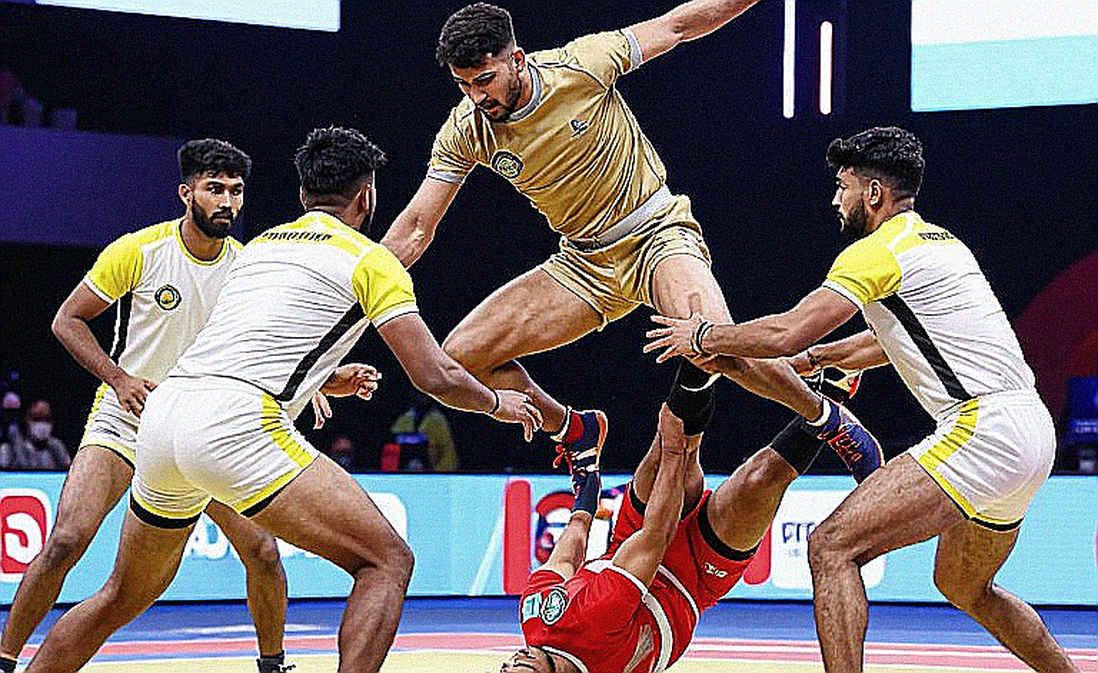
To understand it you have to understand the court first. Kabaddi is played seven-a-side on a 13m × 10m court. One attacker at a time — the raider — enters the opposing half while continuously chanting "kabaddi-kabaddi". That chant, the cant, is not merely a rule but proof the raider is not inhaling; break it and the raid is void. He must touch and return within thirty seconds, or the defenders hold him.
Three scoring rules set the sport's temperature. The bonus line sits deep in the opponent's half — crossing it earns one point, but only when the defence has six or more players on court. After two consecutive empty raids, the third becomes do-or-die: no point and the raider is himself dismissed. And when an entire side is dismissed, the opponent earns two points while every dismissed player is revived.
That last rule is kabaddi's greatest broadcast weapon. A comeback that takes three days in cricket takes one raid here. There is no better raw material for a prime-time window — and that is precisely why the sport's economy changed after 2026.
Before 2026, a kabaddi player was a railway clerk, a police constable, an army recruit. The job was the sport's reward and its security. In July 2026 the franchise auction arrived, and overnight one raider's price exceeded his father's entire pension. It is the most interesting story in Indian sport's recent economics. But note the sequence — the ledger moved first; the stadium only confirmed it later.
Back to Jakarta. The defence Iran built in 2026 came out of a wrestling inheritance. Iranian defenders do not go straight for the waist — they build locks on the ankle and the shoulder joint, chained to each other. Fazel Atrachali became the biggest name of that school and went on to become the Pro Kabaddi League's all-time leading tackle-points scorer.
On what basis did India select for that semifinal? Reputation. Seven previous golds. This is the inferential argument I have fought in previews for years: a decade of dominance teaches you that victory is inevitability, when it was never inevitability — it was an interval during which rivals had not yet built systems.
Iran had built a system. Three years after that defeat, in Pro Kabaddi League Season 5, I built a raid-value sheet at Khel Now. It did not simply add up raid points — scoring raids were weighted apart from empty raids, and do-or-die attempts carried their own weight. On the strength of that sheet I could say on air that Patna Pirates' Pardeep Narwal, with 369 raid points, was not volume-heavy but efficient: his ratio of empty raids was the lowest among the league's top raiders.
Patna won a third straight title that season, beating Gujarat Fortunegiants 55-38 in the final. That is not just a final score. 55-38 shows how that team read the ledger: at the auction it spent on a defensive core rather than raiding courses, and left the raiding responsibility to a player who does not produce empty raids.
Here is where Indian kabaddi's auction economy shows its single largest mispricing. Franchise money chases raiders, because headline raiders build brands. But the 2026 semifinal was lost on tackles — and as long as auction prices for corners and covers remained roughly half a raider's, that error was repeated every season.
Look at the same structure from the other side — at whom the rules reward. Do-or-die makes risk compulsory, which means a defence that knows the third raid is coming can read the attack in advance. The bonus line awards deep raiding, meaning aggression. All-out opens a path back, meaning no score is ever closed. Together these three rules create a game in which the tackle system is valued below raiding talent, even though the result runs the other way.
This is not only Iran's story. It is the story that repeats for any side that buys talent and does not build systems. The talent pipeline has stayed the same — akhada, state team, PKL draft, national team. But today every turn of that pipeline runs on a price set in an auction hall, and that price still undervalues defence.
Now the part coverage reaches least. The narrative Indian media built after 2026 — failure of character, arrogance, bad luck — was comfortable, because it required no system to change. Only speeches. Through off-tube commentary in 2026 and 2026 I watched stadiums sit empty, no crowds, and the tackle data identical. The game had not changed. Only the noise was missing. I learned to read silence the way others read crowd noise.
The genuinely counter-intuitive point is that kabaddi's biggest crisis is not the men's bronze. It is that women's kabaddi owns four Asian Games golds and a 2026 silver — and not one franchise league. The men's league draws year-round coverage. That is an attention economy inverted relative to achievement, and it is the silence nobody wants to read.
The second overlooked item: the Olympics. Tokyo and Paris, both bids made, both rejected. The reasons were not quality — they were participation spread and the state of the women's game. The very thing marketed inside India as a superb product could not produce, on the international stage, the evidence that was demanded.
The third, and it matters more than any trophy: the turf war between mud-court circle style and the standard-style establishment. Circle style controls Punjab's village tournament machinery; standard style controls the league and the Asian Games. Each claims the "real" kabaddi through its own bureaucracy. Meanwhile the non-league circuit outside Haryana and Punjab is almost invisible — no score sheet, no scout.
The governance layer runs inside the same silence. The international federation, the national federation and the league operator pull in three directions. When the national body is consumed by its own internal politics, the part of the talent pipeline that runs from village to state team is the first to dry up — and that drying shows on the scoreboard five years later.
Next time someone writes a preview, my suggestion is plain: write Iran in as co-favourite every cycle, and ask for the date of a women's league. Two Julys, different jerseys, the same question — and it will keep repeating until the ledger is read before the scoreboard.

संबंधित खिलाड़ी
अनुशंसित
Commonwealth Kabaddi Championship 2026: India vs Uganda — The 46-26 'Win' That Proves Nothing2026-10-25
First Commonwealth Kabaddi Championship in Ahmedabad: 62 Matches, 13 Nations — and the 23 That Are the Real Evidence2026-10-27
Never Build a Take on Empty Data: A Kabaddi Analyst's Technical Lesson2026-11-06
Surjeet Singh Captain, Naveen Kumar Deputy — But the Commonwealth Championship File Still Has Three Empty Columns2026-11-09
From Mud to Mat: Who Actually Keeps Kabaddi's Real Record2026-11-12
अनुशंसित
Crores at the Auction, Truth on Tape: In Kabaddi the Third Raiding Option Wins Finals, Not the Headline Raider2026-10-26
Never Build a Take on Empty Data: A Kabaddi Analyst's Technical Lesson2026-11-06
Commonwealth Kabaddi Championship 2026, Day 1: Why Three Teams Sit Above Losers Without Playing a Single Raid2026-10-25
Kabaddi Report Cannot Be Prepared Because Source Material Is Missing2026-11-05
Commonwealth Kabaddi Championship: India Open Against England in Ahmedabad, and the Deal Sheet Turns a Page2026-11-04
अनुशंसित
Commonwealth Kabaddi Championship 2026: Before India vs Uganda, the Scoreboard Arithmetic, the Missing Names and One Date to Correct2026-10-25
Commonwealth Kabaddi Championship 2026: India vs Uganda — The 46-26 'Win' That Proves Nothing2026-10-25
Before Writing a Major Kabaddi Report, One Question Matters: What Can Analysis Prove When the Data Is Missing?2026-11-11
First Commonwealth Kabaddi Championship in Ahmedabad: 62 Matches, 13 Nations — and the 23 That Are the Real Evidence2026-10-27
The Silent Failure of the Kabaddi Data Pipeline: When an 'Empty Report' Becomes the Story2026-11-05